

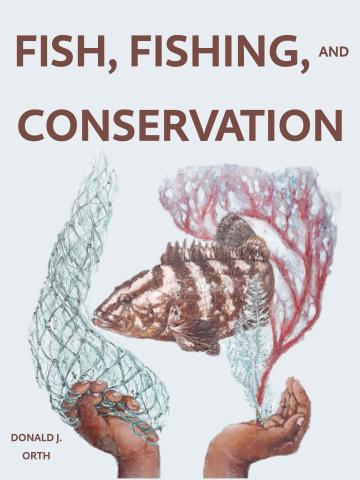
ISBN: 978-1-957213-28-6
People, places, and approaches to fishing are as varied as the diverse fish fauna that exist on the planet. As conservation planners recognize the value of substantial engagement of stakeholders in decision making and ineffectiveness of rigid topdown management approaches, Fish, Fishing, and Conservation asserts that all peoples must play a role in conservation. Through case studies, engaging narrative and graphics, and exercises, the 413-page, undergraduate-level text explores major motivations for fishing and non-fishing related values, responsible fisheries practices, the rights of all people to decide how to manage and conserve fish, their habitats, and how they are utilized. For many fishes, overfishing remains a pressing global problem for which appropriate solutions are not easily found nor implemented.
Introductory chapters examine fish, fishing, and why fish matter and examine the role of values in driving conservation initiatives. Fish and their unique sensory capabilities are described along with a review of recent studies to examine issues of pain, sentience, and learning in fishes living in a foreign, underwater world. The text incorporates new findings in conservation and management leading readers to put ethical reasoning in practice to address welfare needs of wild and cultured fishes. Later chapters focus on the role of gender in fishing, conservation organizations, recreational fishing, and half of the chapters focus on specific fisheries that reveal the principles of conservation and management as they play out in major controversies.
This work is also available freely online at https://doi.org/10.21061/fishandconservation.
Fish, Fishing, and Conservation is a 389-page, peer-reviewed open textbook intended for undergraduate students who are exploring majors in Fish & Wildlife. It is also relevant to a general audience or for use in courses which explore social and ethical aspects of fish, fishing and conservation.
People, places, and approaches to fishing are as varied as the diverse fish fauna that exist on the planet. As conservation planners recognize the value of substantial engagement of stakeholders in decision making and ineffectiveness of rigid top-down management approaches, Fish, Fishing, and Conservation asserts that all peoples must play a role in conservation. Through case studies, engaging narrative and graphics, and exercises, the text explores major motivations for fishing and non-fishing related values, responsible fisheries practices, the rights of all people to decide how to manage and conserve fish, their habitats, and how they are utilized in the context of overfishing as a pressing global problem for which appropriate solutions are not easily found nor implemented.
Introductory chapters examine fish, fishing, and why fish matter and examine the role of values in driving conservation initiatives. Fish and their unique sensory capabilities are described along with a review of recent studies to examine issues of pain, sentience, and learning in fishes living in a foreign, underwater world. The text incorporates these new findings in conservation and management leading readers to evaluate and adopt suitable approaches to ethical reasoning which consider the welfare needs of wild and cultured fishes. Later chapters focus on the role of gender in fishing, conservation organizations, recreational fishing, and a focus on specific fisheries that reveal the principles of conservation and management as they play out in major controversies.
Please visit https://doi.org/10.21061/fishandconservation for more information and associated resources.
Fish, Fishing, and Conservation. by Donald Orth is licensed under a Creative Commons Attribution (CC BY) 4.0 License.
Donald J. Orth is the Thomas H. Jones Professor in the Department of Fish and Wildlife Conservation at Virginia Polytechnic Institute and State University. He has taught the following courses: Ichthyology, Stream Habitat Management, Fisheries Management, Fish Population Dynamics, Fish, Fishing, and Conservation, and First-Year Experience in Natural Resources. His principal interests are in population and community ecology, stream fish ecology, regulated rivers, instream flow and stream habitat assessment, fisheries management, and fish population dynamics. He has guided numerous undergraduate research projects and advised 33 graduate students during his career.
Don attended Eastern Illinois University (BS) and Oklahoma State University (MS and PhD). He is a Life Member of the American Fisheries Society and a Certified Fisheries Professional. He is also a Fellow of the American Fisheries Society, the American Institute of Fisheries Research Biologists, and the Virginia Natural Resources Leadership Institute. Don has published more than 150 primary papers and 50 technical reports on fish, fisheries, and riverine management. Much of his research was also communicated with a general audience in over 180 popular articles. He has received numerous awards for his teaching and contributions to conservation and public outreach. Most recently, the Virginia Chapter of the American Fisheries Society awarded him the Eugene W. Surber Award for years of significant contributions to the field of fisheries science.