

ISBN: 978-1-949373448
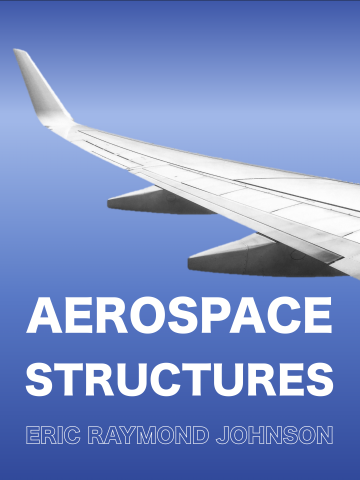
Aerospace Structures is a 600+ page text and reference book for junior, senior, and graduate-level aerospace engineering students. The text begins with a discussion of the aerodynamic and inertia loads acting on aircraft in symmetric flight. A linear theory for the statics and dynamic response of thin-walled straight bars with closed and open cross-sections is presented. Isotropic and fiber-reinforced polymer (FRP) composite materials including temperature effects are modeled with Hooke’s law. Methods of analyses are by differential equations, Castigliano’s theorems, the direct stiffness method, the finite element method, and Lagrange’s equations. There are numerous examples for the response of axial bars, beams, coplanar trusses, coplanar frames, and coplanar curved bars. Failure initiation by the von Mises yield criterion, buckling, wing divergence, fracture, and by Puck’s criterion for FRP composites are presented in the examples.
This work is also available freely online at https://doi.org/10.21061/AerospaceStructures.
Aerospace Structures is a 600+ page text and reference book for junior, senior, and graduate-level aerospace engineering students. The text begins with a discussion of the aerodynamic and inertia loads acting on aircraft in symmetric flight. A linear theory for the statics and dynamic response of thin-walled straight bars with closed and open cross-sections is presented. Isotropic and fiber-reinforced polymer (FRP) composite materials including temperature effects are modeled with Hooke’s law. Methods of analyses are by differential equations, Castigliano’s theorems, the direct stiffness method, the finite element method, and Lagrange’s equations. There are numerous examples for the response of axial bars, beams, coplanar trusses, coplanar frames, and coplanar curved bars. Failure initiation by the von Mises yield criterion, buckling, wing divergence, fracture, and by Puck’s criterion for FRP composites are presented in the examples.
Please visit https://doi.org/10.21061/AerospaceStructures for more information and associated resources.
Aerospace Structures by Eric R. Johnson is licensed with CC BY NC-SA 4.0. https://creativecommons.org/licenses/by-nc-sa/4.0
Eric Raymond Johnson is emeritus professor of aerospace and ocean engineering at Virginia Tech. He earned his doctoral degree in applied mechanics from the University of Michigan in 1976, and from 1976 to 2003 was a member of the engineering faculty at Virginia Tech. Dr. Johnson's research area is composite structures. Research activities include the mechanics of the response and failure of advanced composite material structures with applications to flight and land vehicles, buckling and post-buckling of plates and shells, progressive failure analysis for the prediction of energy absorption in laminated composites and in bonded joints, and fracture mechanics. He has sixty-four publications in structural mechanics, and has been awarded research funding from government agencies and industries. He is a senior member of the American Institute of Aeronautics and Astronautics and a member of the American Society of Mechanical Engineers.